Enhanced Oil Recovery EOR Systems and Facilities
EN-FAB Inc provides advanced enhanced oil recovery EOR systems and facilities to maximize hydrocarbon recovery and extend reservoir life with proven engineering solutions. EN-FAB, Inc.’s Sodium Zeolite feed Water Softening Systems are designed to address corrosion, scaling & steam purity in steam generating and boiler equipment while ensuring efficiency, safety, reliability and engineering considerations.
Each system is custom tailored to specific operating conditions, with overall design based on laboratory analysis or representative samples of “worst case” raw water supply, whenever possible. Treating steam generating and boiler feed water is essential in both high and low pressure systems. Ensuring the correct feed water treatment is implemented before fouling, scaling, and corrosion problems occur, will help avoid costly replacements, outages and future upgrades. With known raw water constituents, and minimum throughput requirements, vessel and component sizing, resin volumes, throughput volume between regeneration cycles, and any necessary chemical treatment provisions are conservatively calculated.
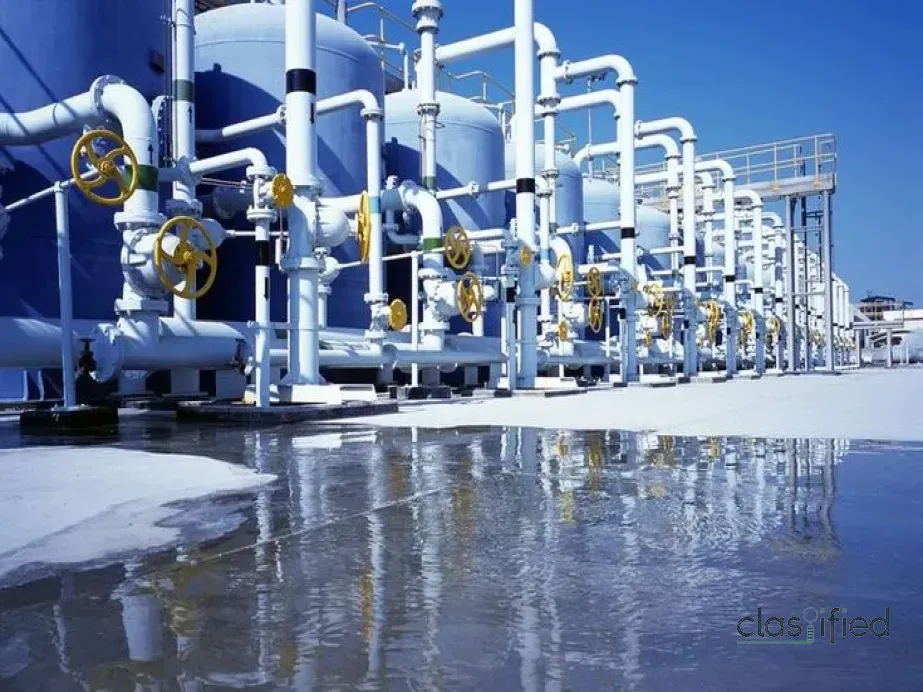
The “series” water softener system consists of two or more “banks” of primary and polisher softening vessels complete with pumps, piping, valving, flow meters and a common brine system for resin regeneration. Automatic controls are incorporated, allowing unattended operation, with operating personnel only obligated to periodically replenish regeneration salt and water treatment chemicals. Regeneration can also be initiated and controlled manually, if desired, but whether the system is manually or automatically operated, electrical interlocks prevent simultaneous regeneration in two or more banks, thus assuring constant soft water delivery.
During the service or softening phase of water softener, the throughput of raw water exchanges calcium and magnesium ions (“Hardness elements”) for sodium ions, while flowing through the sodium zeolite resin beds. After a metered volume of water has passed through the system, the available sodium ions become depleted, and the resin is considered exhausted for efficient softening purposes. Whenever feasible, vessel sizes and resin volumes are selected to allow a minimum of 8 hours service flow before primary vessel resin exhaustion is approached.